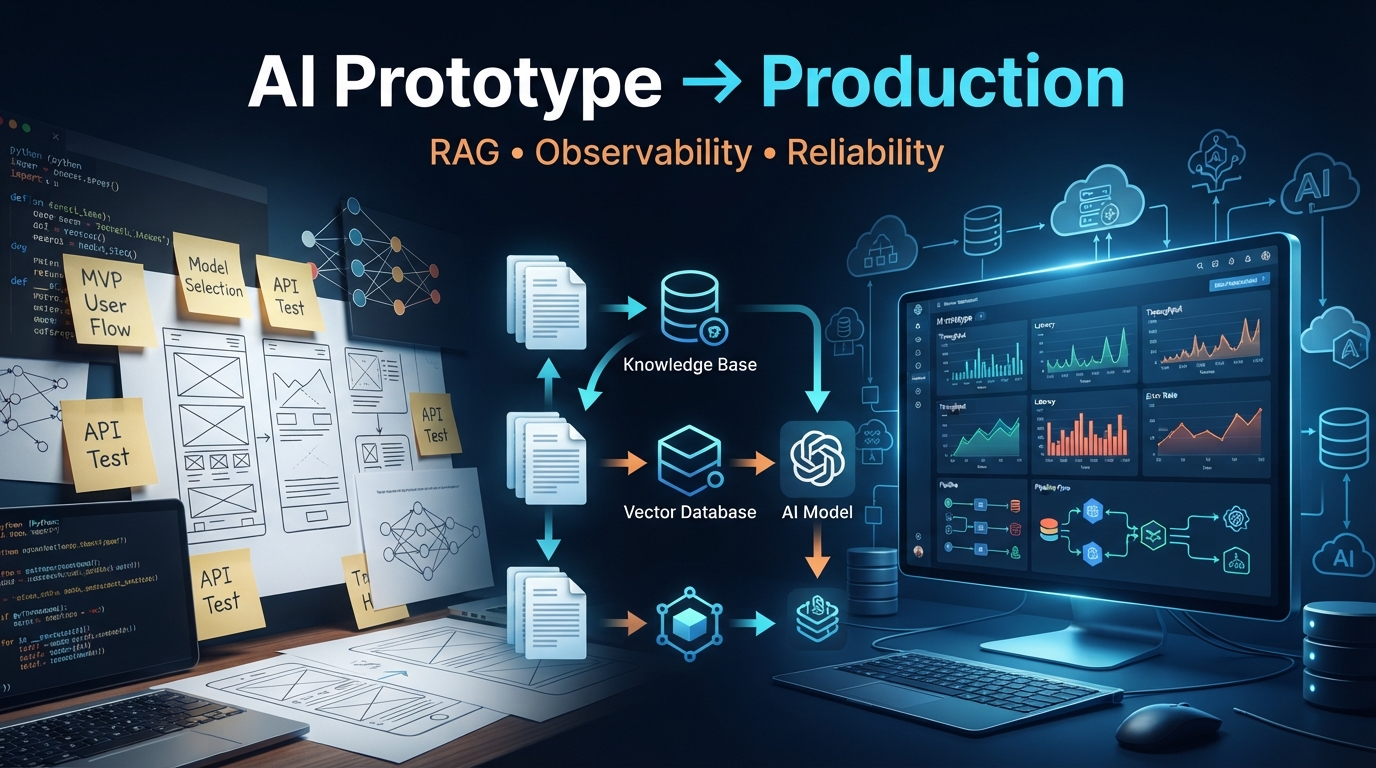
The Gap Between Demo and Production
Most AI demos look impressive. The real challenge is making them reliable, observable, and maintainable at scale.
After shipping multiple AI-powered features in production environments, I've identified patterns that consistently separate successful AI products from abandoned prototypes.
Key Principles
1. Start with the Problem, Not the Model
The most common mistake is choosing a model first and then finding a use case. Instead:
- Define the user problem clearly
- Identify what "good enough" accuracy means for your use case
- Design fallback paths for when AI fails
Always build a non-AI baseline first. This gives you a comparison point and a fallback.
2. Observability is Non-Negotiable
# Always log inputs, outputs, and latency
@trace_ai_call(model="gpt-4", operation="classify")
async def classify_document(doc: Document) -> Classification:
    result = await llm.classify(doc.content)
    metrics.record_latency(time.time() - start)
    return result
Without observability, you're flying blind. Every AI call should log:
- Input (or a hash of it)
- Output
- Latency
- Token usage
- Model version
3. RAG Architecture That Scales
A production RAG system needs more than just vector search:
- Chunking strategy matters more than embedding model choice
- Hybrid search (vector + keyword) outperforms pure semantic search
- Re-ranking is the highest-ROI improvement you can add
Don't skip evaluation. Without proper eval metrics, you can't measure improvements or catch regressions.
Architecture Overview
At a high level, a production RAG pipeline looks like this:
| Component | Purpose | Key Metric |
|---|---|---|
| Ingestion | Document processing & chunking | Throughput (docs/sec) |
| Embedding | Vector representation | Recall@k |
| Retrieval | Finding relevant chunks | Precision@k, Latency |
| Re-ranking | Ordering results | NDCG |
| Generation | Producing the answer | Faithfulness, Relevance |
What I've Learned
Building AI products is fundamentally a product engineering discipline. The ML is often the easy part the hard part is building reliable systems around unreliable components.
The teams that ship successfully are the ones that:
- Start with clear success metrics
- Build incrementally with fast feedback loops
- Invest heavily in evaluation infrastructure
- Design for graceful degradation
This is Part 1 of a series on production AI systems. Next up: Building evaluation pipelines that actually work.